


Shopping Cart
Your cart is empty
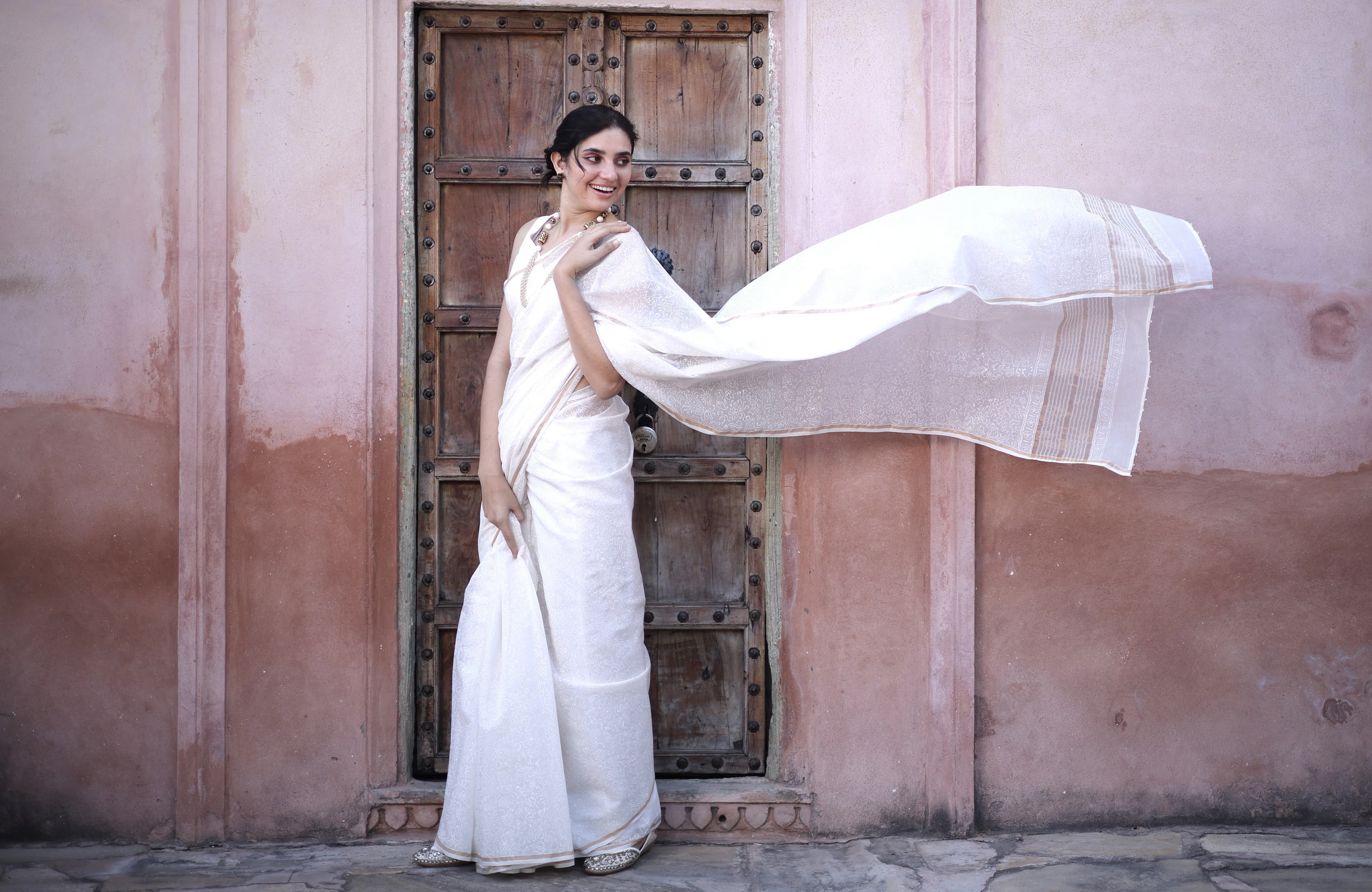
Dressed by Hand
Why the World's Most Discerning Women Are Coming Home to Soma
There's a moment every seasoned traveller knows. You've just landed from three time zones away, your linen is creased, your coffee is lukewarm, and the day ahead is relentlessly full. You reach for the one thing in your bag that never lets you down — something soft, something real, something that somehow makes you look like you planned every moment of this trip.
If you've been wearing Soma, you already know exactly what we mean.
"Clothes are not just fabric. They are memory, identity, and intention — all pressed together by a human hand."
Founded in Jaipur in 1984, Soma has been quietly dressing remarkable women long before slow fashion became a headline. Before sustainability was a marketing strategy. Before block printing appeared on every mood board in Milan and Manhattan. Soma was already there — in sun-drenched courtyards in Rajasthan, working shoulder to shoulder with master block printers whose families have been printing fabrics with wood blocks for generations.
This is not a brand that discovered heritage. It is heritage.
Open your closet honestly. How many pieces in there are actually working for your life — the board meetings, the weekend markets, the long-haul flights, the dinners that start formal and end with dancing? If the honest answer is "not many," you are not alone.
The global fashion industry has spent decades optimising for trend cycles and price points, not for the woman who needs to move through the world with ease and intention. Synthetic fabrics that trap heat on a Delhi afternoon. Prints that fade after six washes. Silhouettes that look perfect on a hanger and exhausting on a body.
Soma offers the quiet alternative — clothing that actually lives with you.
"When a garment is made by hand, it carries a kind of intelligence that machines simply cannot replicate."
The process begins long before scissors ever meet fabric. In Soma's printing workshops scattered across the craft villages of Rajasthan, master craftsmen — the Chhipas — work with hand-carved teakwood blocks, some of which have been in continuous use for generations.
A single kurta set may pass through twelve pairs of hands before it reaches you. The cotton base cloth is stretched by hand. The vibrant, skin friendly, Soma colors - earthy brown, shades of indigo, marigold gold, soft green, pale pink,white — are prepared fresh each morning. The block is pressed with a deliberate, rhythmic force that takes years to perfect. Too light, and the colour won't saturate,too heavy, and the motif bleeds.
And here is the beautiful truth of it: no two pieces are exactly alike.
The slight halo where one stamp ends and another begins. The way the terracotta deepens slightly at the edge of a petal. These are not flaws. They are the fingerprints of the person who made your garment. They are proof of life.
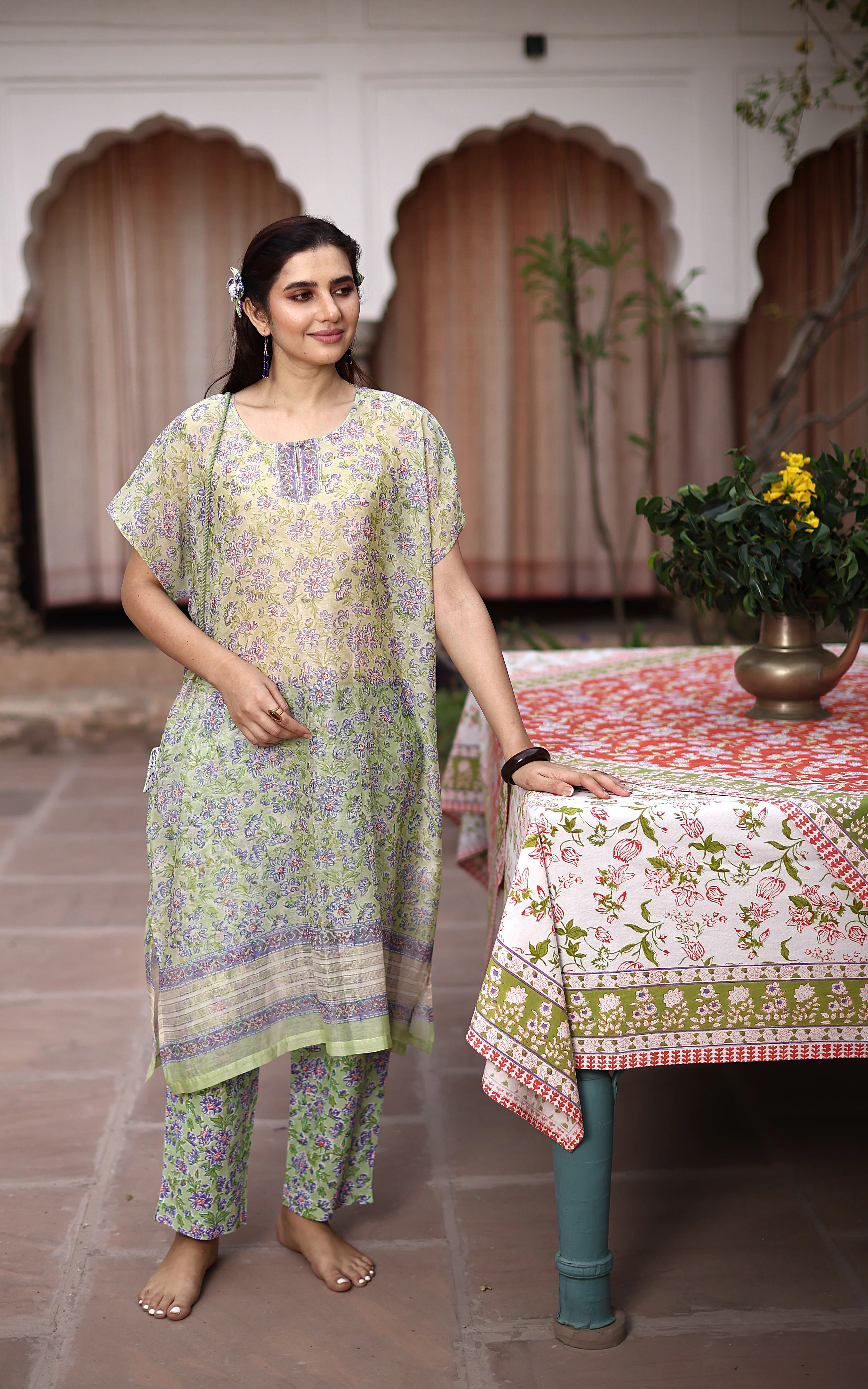
Soma's signature white on ivory floral block print cotton kurta sets have become something of a quiet cult among women who know. There is a reason for that beyond aesthetics. Add to this Apple Blossom motif printed with pale mint and skyblue colors.
Long-staple cotton — the kind Soma uses — is woven with deliberate airiness, creating a natural thermoregulation that no synthetic can match. On a 42-degree afternoon in Rajasthan or a humid July in Singapore, the difference between a Soma kurta and a polyester alternative is not subtle. It is the difference between feeling present in your day and counting the minutes until you can change.
.webp)
The benefits go beyond comfort:
✦ Natural fibres breathe with your body, regulating temperature without trapping heat or moisture
✦ Skin-safe pigments mean no chemical irritation, even for the most sensitive skin
✦ High-grade woven cotton resists pilling and distortion — these garments look beautiful for years, not seasons
✦ Fully biodegradable at the end of their life — circular by design, not by marketing
✦ The weight and drape of a well-made cotton set moves with your body, not against it
.webp)
Aesthetically, the white and ivory palette is one of those rare combinations that flatters every skin tone. Pale mint and sky blue accents look striking against both deep and fair complexions, creating a quiet drama. Pair the set with gold jhumkas and leather juttis for a gallery opening, or switch to crisp white sneakers and a woven tote for a long Saturday in the city.
The coordinated matching set — a printed kurta with its palazzo counterpart — has become Soma's most beloved category, and it's not difficult to see why.
For women whose days move quickly between contexts, a well-designed coord set is a small revolution. You are dressed. Fully, completely, intentionally dressed. The print carries across both pieces in the way only a handmade garment can guarantee — because when the same craftsman stamps the same block on the same morning's dye batch, the colour marriage is inherent.
"The right outfit isn't the one that makes you look good. It's the one that makes you forget you're thinking about what you're wearing."
The wide-leg palazzo cuts at Soma are engineered for movement — generous enough to circulate air freely, tailored enough to look polished. The mandarin collar variants add an architectural element that translates effortlessly to formal environments. A structured jacket layered over, some silver filigree at the ear, and this is boardroom dressing of the most considered kind.
For the airport, the bazaar, the weekend retreat — remove the jacket, add a stack of bangles, feel the fabric move in the breeze. Same outfit. Different woman. Same ease.
1984. Jaipur. Before the internet. Before globalisation made heritage a selling point.
Soma was established not as a business experiment but as a commitment — to the craft families of Rajasthan who had inherited centuries of knowledge and deserved a future for it; to the Indian woman who deserved something beautiful made by hands that cared; to the global woman who was, the founders believed, ready for something real.
They were right.
Today, Soma operates its own dedicated production spaces rather than outsourcing to anonymous factories. Every stage — from the initial woodblock carving by local craftsmen in Sanganer and Bagru to the final sun-curing in open courtyards — is held within a transparent, traceable, human supply chain.
When you buy from Soma, you are not funding a faceless supply chain. You are paying a fair wage to a master craftsman whose children may one day continue this work. That is not marketing language. That is the direct, verifiable result of forty years of community-first practice.
We hear from women across the world who are building their wardrobes more intentionally — investing in fewer, better pieces rather than more, cheaper ones. Here are the conversations we find ourselves having most often.
Where do I find genuinely authentic block print textiles online?
The honest answer is: it's harder than it should be. The market is flooded with machine-printed imitations sold with the vocabulary of handcraft. Soma's online store and mobile app give you direct access to the actual production source — pieces documented from printing table to your door, with no third-party aggregators involved. Limited-run collections mean you are genuinely acquiring something that not everyone else has.
Is traditional Indian clothing compatible with a contemporary professional wardrobe?
Completely — and we'd argue it's more compatible than most Western formalwear for women navigating a global professional life. A tailored kurta with straight-cut trousers in a refined print reads as put-together in a Mumbai boardroom, a London conference, a Paris dinner. The silhouettes are clean. The fabrics are always appropriate. And the cultural depth adds a dimension of visual interest that generic formal dressing simply doesn't carry.
What's the difference between a Soma garment and what I see in a fast-fashion store?
Beyond the obvious — handmade versus machine-made, natural versus synthetic — the most meaningful difference is longevity. A Soma kurta set, cared for properly, looks better at five years than it did at five weeks. The natural dyes deepen and settle. The cotton softens with washing into something almost impossibly pleasant against the skin. Fast fashion, by design, is not meant to last. Soma, by design, absolutely is.
There is a growing movement among the women we admire most — the designers, the editors, the diplomats, the artists, the entrepreneurs — toward what might be called wardrobe integrity. Fewer pieces, deeply considered. Clothing that tells a story rather than follows a trend. Investment in craft rather than consumption of volume.
Soma's block-printed collections are built for exactly this kind of wardrobe. These are not statement pieces you wear twice and retire. They are workhorses of a different kind — the garments you reach for because they always work, always feel right, always travel well, always make you feel entirely like yourself.
"A wardrobe built with intention is one of the quietest forms of self-knowledge."
The Soma app and online store carry the full range of seasonal collections, with detailed information on each piece's printing origin, fabric grade, and artisan workshop. New arrivals are limited by the pace of handcraft — which means, if something speaks to you, it's worth not waiting.
Some things are made faster with machines. Some things are made better by hand.
Soma has known this since 1984.